
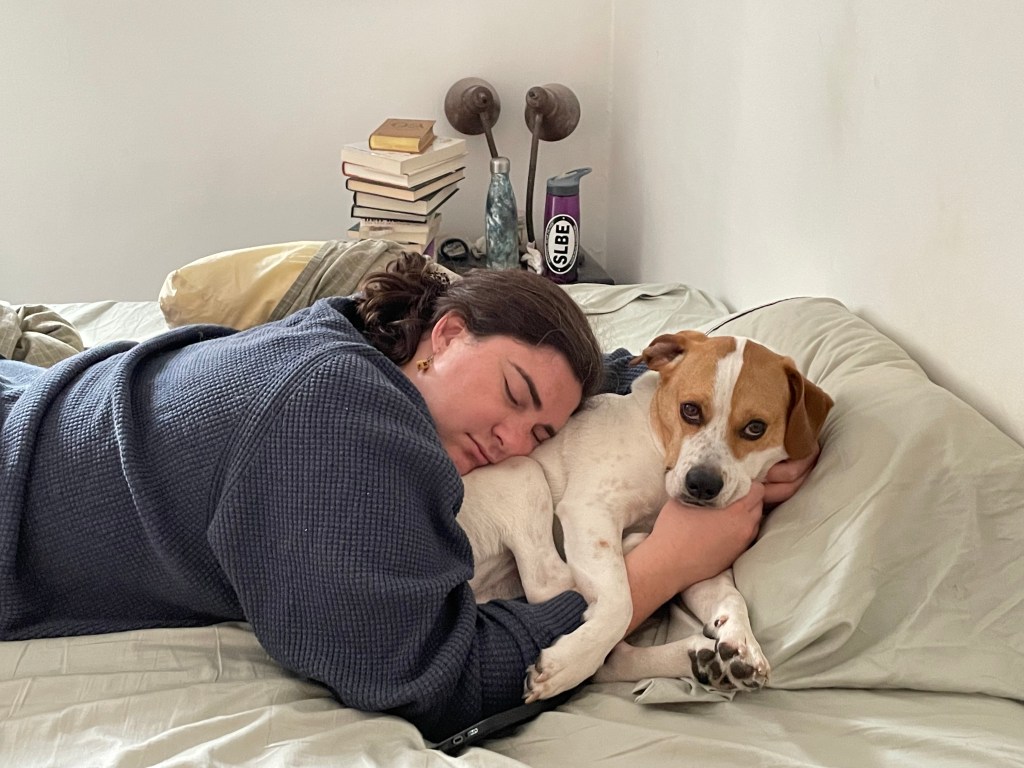
I first heard Jordan Davis’ Next Thing You Know a few months after meeting my fiancée. We were not engaged at the time, but certainly moving too fast. We met in September, and by December, Nikki was sleeping at my place most nights. She’d complained about the sorry state of my mattress two months in; hundreds of dollars and an IKEA trip later, she was satisfied (and I’ll admit, I was also more comfortable). I shared Davis’ sweet country song ,about a life full of love flying by, with her as soon as I heard it. Lying on our new mattress, we laughed at how our early timeline mirrored his.
We also grieved to this song. Nikki and I will never experience the easy magic of not “really trying” and waiting for a cheap test on the counter to change the entire course and meaning of our lives. Nikki and I cannot have biological children, though we both want badly to be parents, to care for a child or two, to watch the whole course of some unique soul’s becoming. We may not want to change dirty diapers, or argue about a few bites of broccoli every night for a couple of years, but who really does?
Of course, like many millennials, we worried with each other about the morality of bringing a child into a world so filled with uncertainty and danger and division. Nikki worried about her experiences of depression, not wishing that pain on a non-consenting child. I argued that the joy of experience, in most lives, would outweigh the pain. That I would never choose not to suffer if it also meant I never knew how it felt to smile and nestle close with Nikki on her couch. Admittedly, this overwrought philosophy was also a clumsy attempt at seduction, punctuated by deep kisses.
We had these conversations even knowing there was no easy way for us to make a child. That is a hard thing. I’ve had friends, a few years older than I, struggle with infertility. I am a therapist and have discussed infertility with a few clients in my career. Though, as a culture, we don’t often discuss it, 15% of American couples deal with some degree of infertility. The silence around it makes it harder. The ways we tie femininity to fertility and to motherhood make it especially hard for women. Masculinity too, is tied to virility, which is part of why Elon Musk is so obsessed with impregnating as many people as possible, despite showing minimal interest in his progeny. The gendered weight of infertility is especially hard for me and Nikki.
As Nikki and I were getting to know each other, I had a male client share with me his fertility journey and his insecurity that his low sperm count reflected negatively on his manhood. I winced internally because I am a transgender man, and my sperm count is a predictable and permanent zero. And many people would say, for that reason or others, that I am not a man. I have also had a hysterectomy because I do not believe I could survive the changing of my body that might come with pregnancy. I’ve lived in a body that everyone saw as female, and it ate away at me. I have changed that body, found so much joy, and will never go back. My fiancée, Nikki, is also transgender. She has frozen her sperm but, between us, we cannot find a womb.
I am aware, writing this, that the people who argue vehemently against gender-affirming care for transgender people, use infertility as their knockout punch. “Certainly,” they say, “that is too large a price to pay!” So, I want to be clear: I want children, but I also want to be a great parent to them. No matter how much practically easier reproducing might have been if I hadn’t transitioned, I would never have been able to be present and happy and authentic with whatever children I might have had. And that’s if I could even survive a pregnancy. There are many treatments that might cause infertility. That does not mean they are not life-giving and saving treatments. I wonder how often parents say they are worried about their trans kid’s fertility, when, deep down, they are really scared because they know how poorly transgender people are treated in this world. Few parents hope for hardship for their children.
And lots about life is harder now than it was before transition, though I feel more joyful. Nikki and I are preparing for our wedding, and our parents are showing up with generosity. We were welcomed when we walked into the jewelry store down the street to talk about wedding bands (though the two of us argued plenty over what we wanted). Yet, in this joyful time, we watch the news with fear, wondering how long our married life might last here, before medical neglect or criminalization of the ways we dress or of where we pee, chase us away or separate us. Perhaps the timeline is even shorter. Just this week, my picture was defaced on a poster advertising therapeutic support for transfeminine people. Will hate find our address online and follow us home? I worry every week that Nikki will be thoughtlessly killed on the train ride home from school, as too many trans women are. And everything will change: the Next Thing You Know, “it’s 11:01 wonderin’ where they are.”
It’s funny, listening to that song on the radio, driving home from work, all the feelings that come up. The song is nostalgic, full of hope, and simpler than real life. At times, listening, I am filled with love. I look down at my hand and imagine my “left hand getting used to that ring” this October. Then I have the urge to see when Jordan Davis might be in town and remember that we would not feel safe at his concert. That so many other people who love this song, who have lived the dream Davis describes, or want to, do not want it for us. I worry about stares or slurs or violence at this imaginary concert. I Google “Jordan Davis transgender,” wondering how he might personally feel about me, about my fiancée, and find that there is a transgender woman in England who shares his name. I add “country music” to my Google search and find nothing. Jordan Davis, country star, has not said anything publicly about transgender people. A hopeful part of me thinks, “well at least he hasn’t said anything bad.”
But, as anti-trans voices grow, even silence scares me. I know that trans people alone cannot possibly scream loud enough to protect ourselves. I also know that some of my fear is based in a stereotype. At Jordan Davis’ imaginary concert, many would welcome us, and more would let us be. Sometimes, I worry about being stereotyped in this way. In LGBTQ settings, really in most of the liberal circles I run in, I hide my music tastes. Online, country music fans post about being assumed bigots when they share their love for the genre. Only some are. Then again, I feel a lot less threatened by stereotypes about country-lovers than I do by stereotypes about transgender people.
Part of the irony, for Nikki and me, is that we are “straight with extra steps.” Even an oppressive government that ignored gender identity and our own self-knowledge would have to concede that we are a heterosexual couple. I feel this acutely as we prepare for our wedding; some of Nikki’s family members will not be attending because they’ve made it clear that they will not respect us or our guests. If we’d met before we transitioned, or if we were now marrying but in the opposite outfits, everyone would be thrilled. Our love, which would be no different, would be celebrated. The ceremony might even hint (however explicitly) at our time in the bedroom. Certainly, in Nikki’s Catholic family, the priest would wish for our fertility, and welcome God’s love into our marriage. Perhaps Nikki would remove my garter at the reception. I’ve even seen people do this with their teeth. But no one claims the straights are “flaunting their sexuality” or “rubbing it in our faces” when the groom sticks his head under the bride’s dress.
Truthfully, I can be a bit of a prude and I have plenty of friends who make me blush, trans or not. Nikki and I are pretty vanilla, we want basic things. By which I mean both basic rights and the basic bitch, heteronormative life. Athleisure wear and a fall wedding (though no pumpkin spice). Safe places to use the bathroom, healthcare, a life that eventually falls roughly into what was expected, even if we’re playing different parts.
Now not every trans person wants these same things (though actually we’re pretty much all agreed on the rights part). Lots of people, in any group, desire something different. Though trans people are more often forced outside the norms where they can get a clearer view of what doesn’t work in the scripts we’re given. When I work with my clients, this is what I most wish I could share with the world: among trans people you will find assholes and narcissists, great senses of humor and some gentle and fiercely loving hearts that should be cherished. Some are Average Joes or Janes or nonbinary Jamies. Others are the sort of bizarre, provocative people whose lives are all drama and part art. Knowing the transgender community is like knowing any community in its diverse and imperfect whole. There are infinite ways to live a good life and more ways to at least get by.
I am writing this as Trans Day of Visibility approaches and I am trying to convince you that I am human by showing you what we have in common. I’m also hoping you can extend love to my friends and clients who are, maybe, less like you, because similarity should never be a requirement for compassion. Next thing I know, I hope Nikki and I will be married. I hope our world will feel less hate, have more dialogue, connect with true curiosity. I hope our lives will be safe enough to reach for simple dreams. Safe enough to get creative and see what parenthood can look like for us. Next thing I know, I hope my friends and clients are also allowed to reach for their dreams: to work and create, to love in whatever ways most fulfill them, to just be themselves as best they can.
But right now, I am waiting at home for my fiancée to return from her long day driving Lyft. She sends me texts throughout the day, every day she drives. Little stories of the people she encounters. There are lows: some riders misgender her and apologize profusely. Others are scornful, or drunk and leering, or simply obnoxious. Other meetings leave a better mark. One morning, Nikki texted me: “I just met the sweetest old lady. I had to help her into the car. I folded up her walker… She and I talked about her late husband and my future husband… she was talking to me about how God still wants her here but she feels so old and not sure she wants to be here anymore and I said… well I got to meet you, maybe that’s why you’re here… she shook my hand, she asked for my phone number… it was just a really lovely moment, someone who lost her husband recently and someone who’s going to gain a husband soon.” I smiled a bit and put my phone down, a little more hopeful.
– Felix


 DCC: Deiss Composition Collection
Leave a comment